

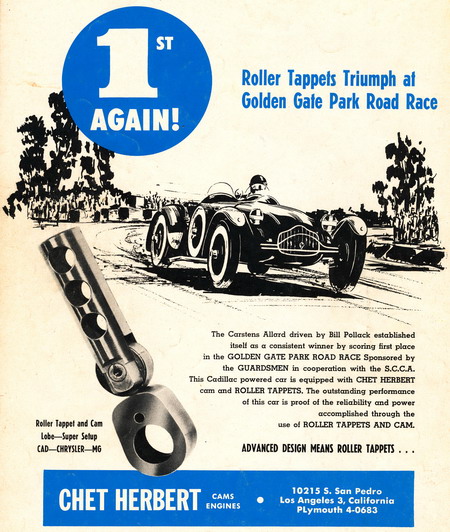
1st Again!
/
If you find a story below interesting, please click the "Like" button...Thank You!
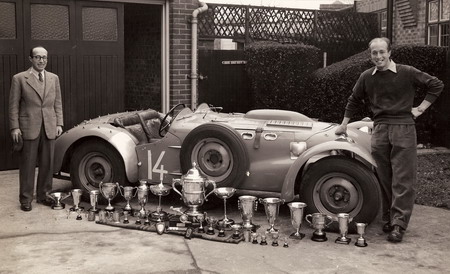
The Wick brothers were longtime friends of Sydney Aallard and enjoyed much success in his cars. Over the years, Maurice (left) and Cyril (right) had owned several Allards including a pre-war special, a J1, two M's, and the J2 pictured above. Sadly, Maurice passed in 1981, but Cyril still leads a very active life. As you can see, the Wick brothers were very succesful in motorsports.
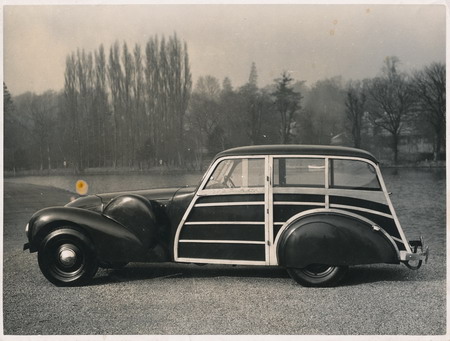
According to Wikipedia, the first "Shooting Brakes" were developed "in the early 19th century, a brake was a large carriage-frame with no body, used for breaking in young horses, to restrict (or "brake") their movement, and train them as work horses. By the late 19th century the term extended to an open-bodied wagonette designed to carry a number of people. A "shooting brake" carried a driver and gamekeeper facing forward and up to six sportsmen on longitudinal benches with their dogs, guns and game carried alongside in slat-sided racks.
The term was subsequently applied to custom built luxury estate cars altered for use by hunters and other sportsmen such as golfers, riders, and polo players requiring easy access to larger storage areas than offered by the typical automobile boot."
This Allard Shooting Brake was likely supplied as a chassis only to an independant body builder. If you know anything about this car, please contact us!
By Chris Lowth
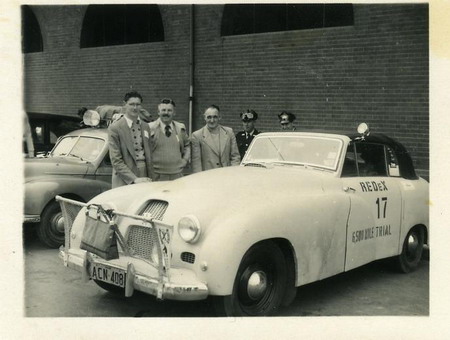
That original 1953 Redex Reliability Trial remains as a watershed in endurance rallies in Australia, up to that time it was the second longest trial ever staged in the world (the previous longest had been from New York to Paris in 1908). It was an expedition into the unknown.
It was organized by Dunlop executive Harry James, who in 1904 had organized Australia's first motor race meeting, a four event "demonstration" at Aspendale racecourse in Victoria. James, who was generally regarded as the father of Australian motor sport, was also a great-uncle to arguably the biggest name to ever grace an Australian racetrack Peter Brock.
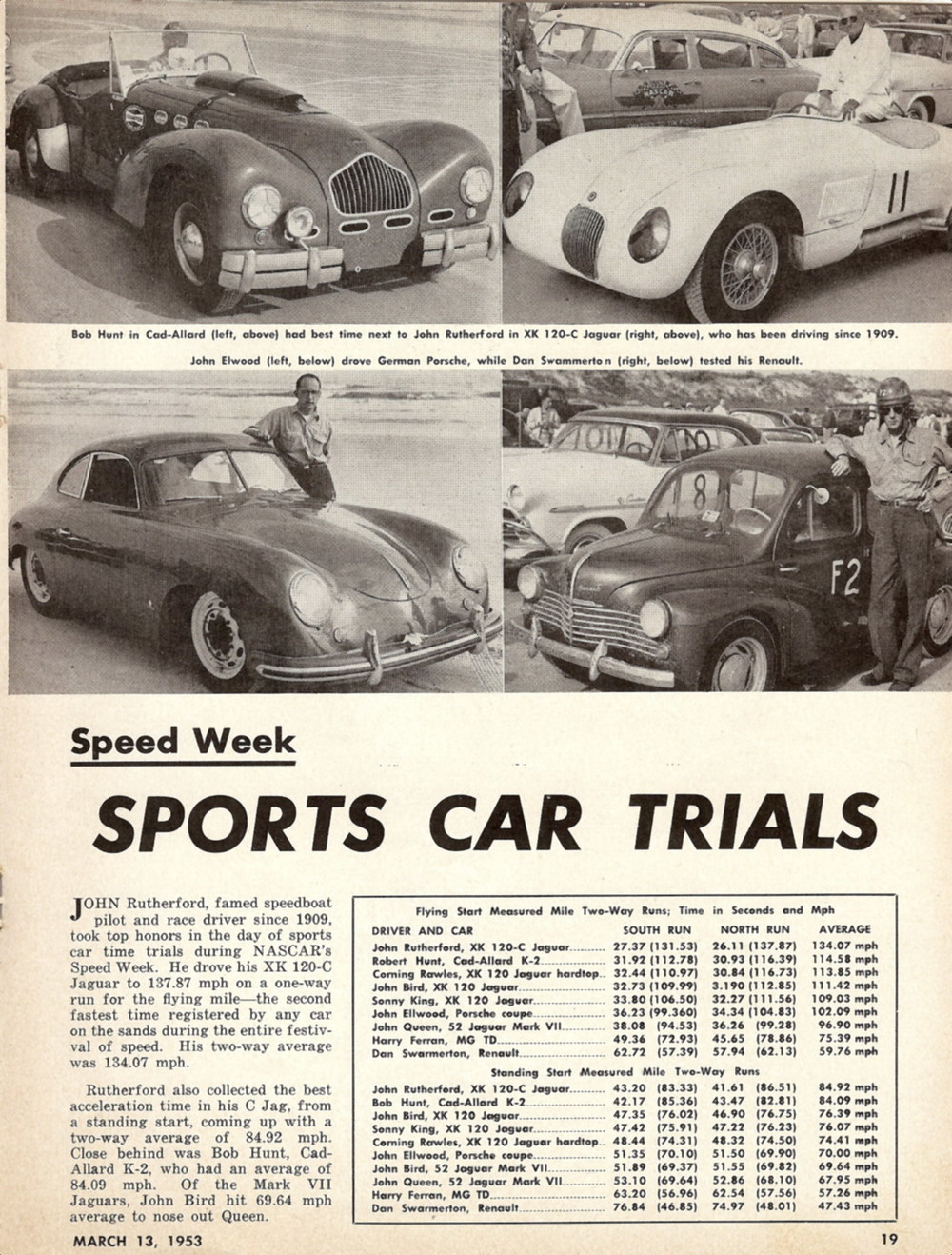
Before the Daytona 500, Nascar hosted their Speed Week event in Spring on the sprawling sands of Daytona Beach. It's not known how many Allard's raced there, but in 1953 NASCAR had a sports car class. Robert "Bob" Hunt took his K2 there to compete and did quite well finishing second to probably the fastest sports at that time, a Jaguard XK-120C. Bob completed the standing mile with an average speed of 84.09 mph (the C-type was a hair quicker at 84.92!) and flying mile at 114.58 mph. The flying mile speed demonstrated superior aerdynamics [and gearing] of the C-type, which finished with an amazing average speed of 134.07 mph...besting Mr. Hunt by almost 30 mph (or 4 seconds)! Either way, the times and speeds posted by Mr. Hunt and his K2 were very impressive...although we must wonder what a Allard J2X-LM or JR could have done... Click here or the image above to view the full size image.
This scan came from the March 13, 1953 issue of Motor World magazine.
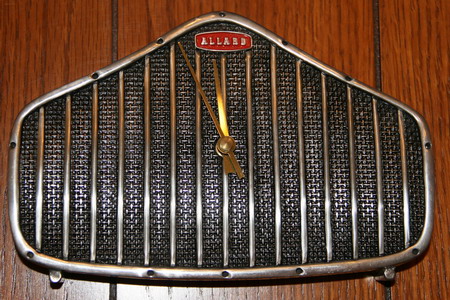
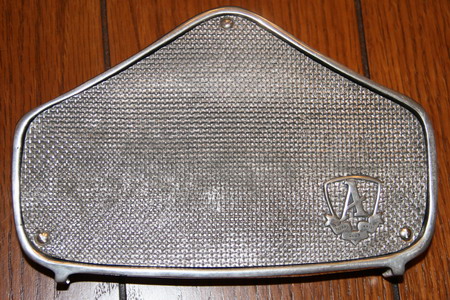
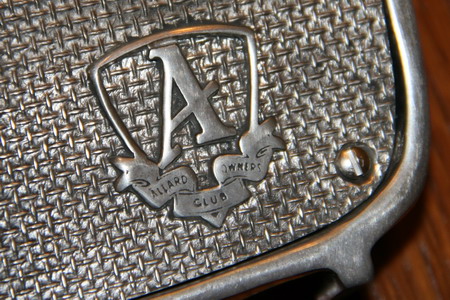
One of our generous members sent us this amazing clock the other day for our archives. The free-standing clock is made from cast pewter and measures 8" wide X 5 1/4" tall and weighs several pounds. Little is known about the clocks except that they were made here in the US several years ago, with a limited run of 100...this is clock #14. The clock movement is nothing special, it's just a AA normal battery powered unit like you'd find in most wall clocks nowadays. If you know any more about these clocks, please let us know!
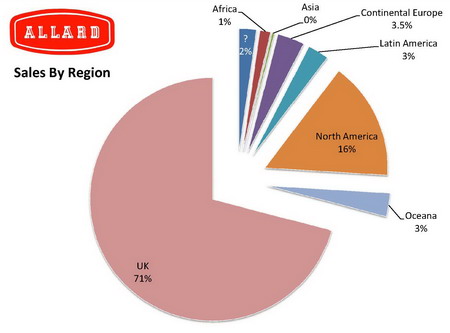
Over the next few weeks, we'll be presenting a number of charts representing various Allard statistics based on the database we received from the late Tom Lush. We hope you find them interesting...or at least not too boring!
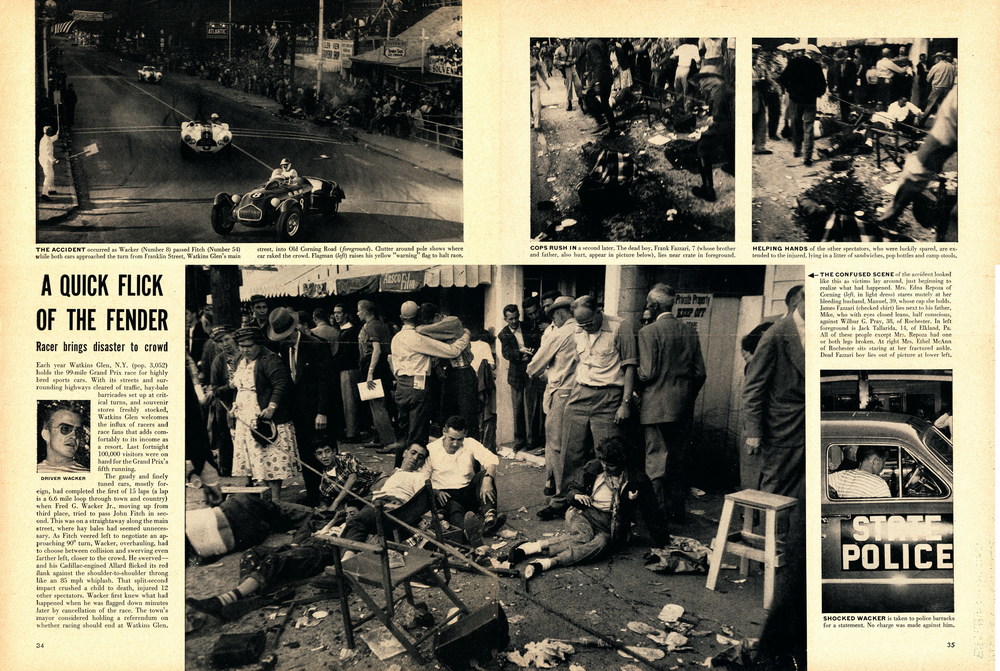
While going through our archives, I found this amazing piece of history. The photo above is a small excerpt from a full page spread in a magazine that we believe to be Life Magazine (unfortunately all we have are these pages). The story was likely published the week after the infamouos 1952 Watkins Glen Grand Prix in late September. In addition to the photo above, the story features a large, disturbing photo of the post-crash scene. To my knowledge, these photos have never been seen outside of this article. Click here or any of the photos to view the large (7MB) image. If you have any more info on this magazine, please let us know.
As you know, this accident had a dramatic effect on sports car racing in America. It highlighted how vulnerable spectators actually were and that their safety was critical. The aftermath of this unfortunate accident led to the creation of dedicated road courses and airport tracks that kept spectators at a safer distance.
Note: The story and photos have been posted without permission and will be removed upon request.
From Lindsey Parsons...
Those photos and article on the Wacker accident were indeed from page 34 and 35 of the Oct. 6, 1952 edition of LIFE magazine. If you look carefully at the picture, you will notice that Wacker's left door had been opened by the contact. At the time I was a spectator standing with friends about a quarter mile up the course on Old Corning Hill Road when the race leaders passed at full chat. Wacker's "Eight Ball" was surrounded by a bevy of Cunninghams but they all were definitely at full throttle climbing the hill. I am absolutely certain that Fred Wacker was totally unaware of the tragedy his "flick of the fender" caused back on Franklin Street. Although he appeared to be concentrating on his driving he was reaching out with his left hand on the left door trying to secure it closed when he passed us. When the cars passed from our view, he was still struggling with the door but was keeping up his position in the very rapid procession. Although I was intently watching Wacker specifically as he was a contending leader in a car I was about to order, I didn't notice any damage to the left side of the the car except for the door being unsecured. We were on the south side of the hill road so we had a a good view although a very short one of the left side of the Allard when it passed. I did wonder about that later but figured that I was so interested in Wacker's efforts to secure the door, I simply didn't notice what damage was done to the left rear fender. It couldn't have been much however as it clearly was not effecting the car's performance as it would have been if it was contacting the tire. As I recall, it was some time before we actually heard the reason the race so abruptly ended. One of the nearby flagmen heard it on the race radio he had with him.
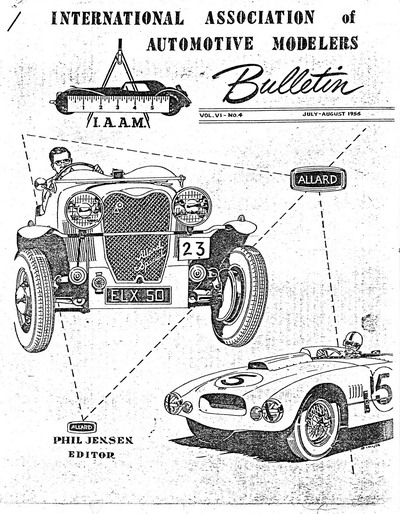
Back in 1956, the International Association of Automotive Modelers (IAAM), featured the Allard Motor Company in their July-August Bulletin (Vol 6, #4). The Bulletin includes 12 pages of line art sketches of all the Allard models. Click here or the image above to download the complete Bulletin. Enjoy!
One of the more rare Allard cutaway drawings comes from the boys weekly comic book, "Eagle, Volume 3 Number 10, June 13, 1952." Although not exactly drawn to scale, it is impressive for a comic.
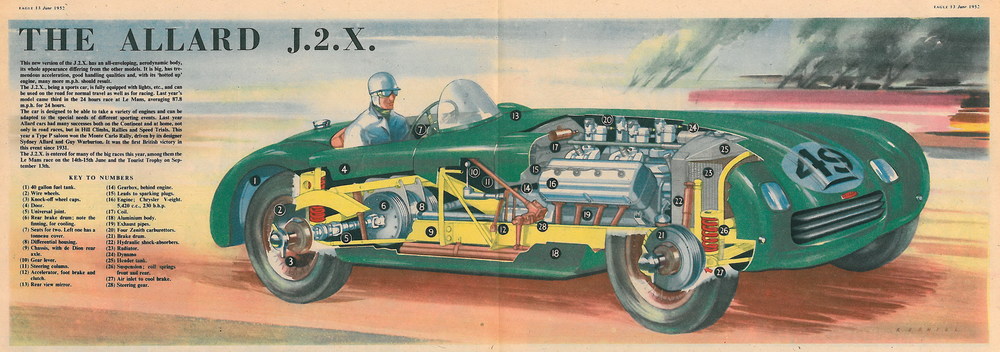
Click here or the image above to view the hi-res version. Special thanks to Kerry Horan for sharing this!
Bet you haven't seen this one before...
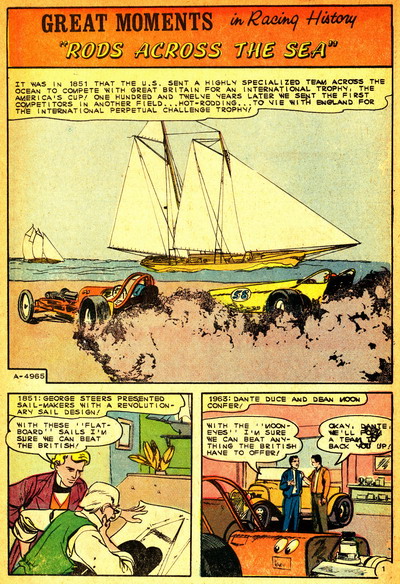
In August of 1965, the comic book, "Drag-Strip Hotrodders" published a brief history of the 1963 intercontinental drag race duel between the Americans Dante Deuce and Mickey Thomson and the Brit Sydney Allard. The story takes more than a few liberties, but c'mon, it's a comic book! Special thanks to Kerry Horan for sending us this jem. Click hereor the image above to download the pdf. This comic was published by the Charlton Comic Group, Illustrator/Author unknown.
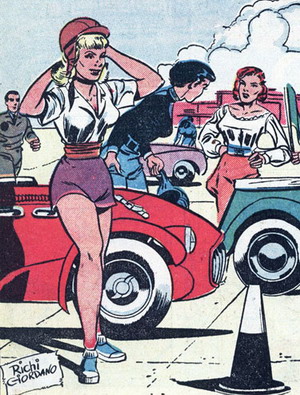
You have to love the internet. If you look hard enough and know the right words to search for...you can find some great stuff. The other day I was reading the H.A.M.B. and I found this great comic about a wife that bought an Allard J2 so she could win a race to pay the mortgage on the family home, which of course was due to be foreclosed. Who knew that 60 years later the story would still be so relevant!
This story was printed in the comic book, "Hot Rods & Racing Cars" (Issue #10, 1951) and was penned by Dick Giordano, aka Richi Giordano.
By Richard Saunders – with Chuck Warnes and Otto Meijer
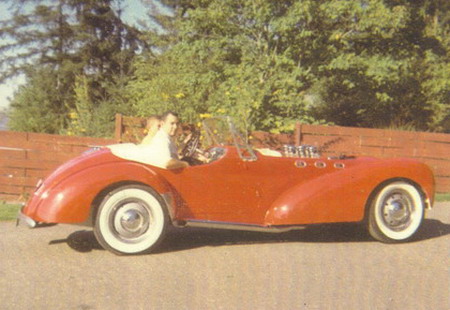
Back in 1959 I drove my J2 Allard (No. 2156) over 1300 miles from San Diego CA to Bremerton WA. I underwent some major surgery at that time, and after an extended recovery I was finally able to drive the J2 again.
The young guy delivering newspapers on local roads (herding a used-up Model A Ford) noticed my J2 Allard. He soon found an opportunity to pay me a visit. ‘Skip’ Torbitt was seventeen, small in stature, and appeared a lot younger. We talked a lot about cars, and I gave him a ride in my J2. During a subsequent visit Skip announced that if I knew of any Allard for sale, to please let him know – as he decided he had to have an Allard. (I’ll never know how he convinced his parents).
Fate stepped into this scene. A few weeks went by, and we saw an ad for an Allard in the Seattle newspaper. Skip arranged to see the car, and I was recruited as the Allard expert to accompany him on the ferry over to Seattle. We then commenced our hunt for the address through the West End streets. Then, as we entered one street a bright red K2 Allard caught my eye.
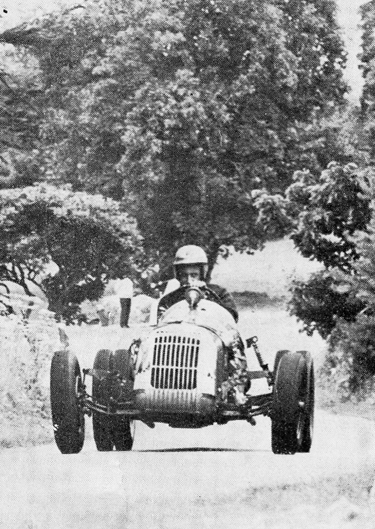 David Hooper racing up the Valence Hill Climb in Sydney's old Steyr racer. You can see the Steyr at Amelia Island this March.
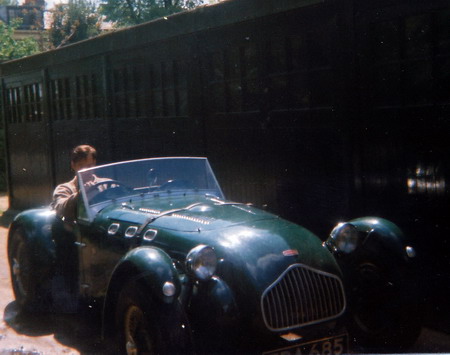
-By Bob Judd
It's tempting to see these cars as holy relics; vessels of memories, style and dreams. Emblems of their art and time.
Well screw nostalgia. My old Allard J2, (Chassis #2121, now owned by Martin Stickley - soon to be available for viewing at Amelia Island Concours D'Elegance next March), was a wild beast you rode bareback, no helmet, no seat belt, no nothing, your butt a few inches off the pavement, the pavement visible in the spaces between the aluminum floor panels.
By David Hooper
The ‘Atom’ project originated from Ronnie Green the promoter of Wimbledon Speedway who placed an order with the Company to build a prototype 500cc JAP powered small ‘dirt track’ style car. In the 50’s speedway was beginning to lose its appeal due to rather processional racing with little overtaking, and the winner usually being the leader after the first corner – nothing new!
By David Hooper
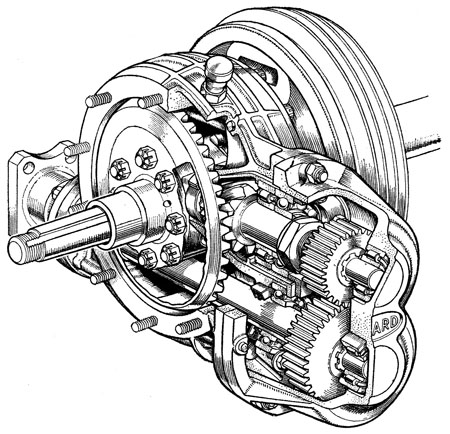
In 1952, the Allard Motor Company offered a modified dead axle assembly for the J2X complete with removable center section to allow the Halibrand quick change differential to be easily retrofitted to the USA cars. Due to high import costs, it was not cost effective to import quick change differentials from the USA. However, due to interest from existing Allard owners plus HWM, it was decided to make an Allard version.
(Click here or the photo above to visit the site)
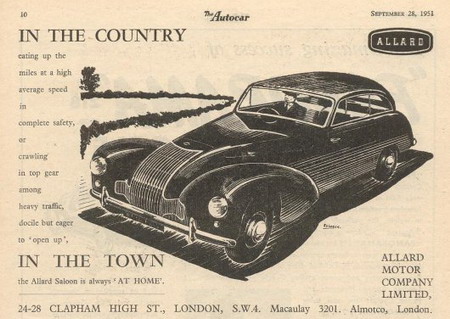
Here's an interesting web site that you need to check out, www.car-brochures.eu. It's packed with scans of car Brittish car brochures and advertisements from the past. Sadly, there are no Allard brochures (yet), but there are over 80 Allard advertisements ranging from 1946 to 1957. The adverts are very interesting to look at, especially when compared to todays ads. Special thanks to Hermann Egges for creating such an interesting web site (and thanks to Kerry Horan for the telling us about it!).

By Ed Reed
Reading about the plans underway for an Allard Gathering at Watkins Glen this September, in the Allard Register, brought back memories of the first time I attended the Grand Prix back in 1952, as a spectator. Little did I realize it would be the last year of the original road course.
